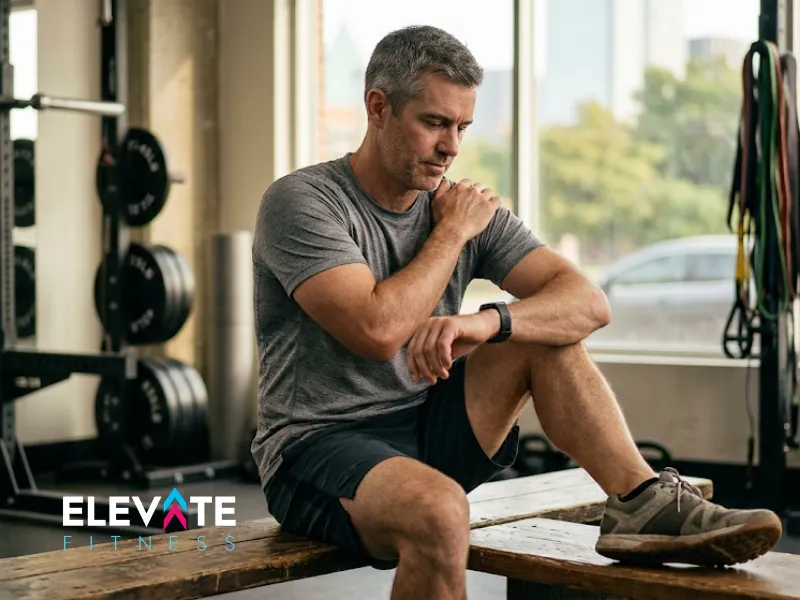
Certified Fitness Trainer Explains | Why "Move More" Is the Worst Advice You Can Get After 35
If you've been told to just move more to get back in shape, you're not getting bad intentions - you're getting incomplete information. And for a lot of people in Dallas, juggling careers, families, and everything in between, incomplete information is exactly what's keeping them stuck.
Here's the truth: moving more works - until it doesn't.
For a season, adding a few extra walks, a spin class here and there, or a weekend workout feels productive. You see some early changes, feel a little better, and think you've figured it out. Then the results stall. Your body starts feeling tighter instead of stronger. You're putting in consistent effort and getting almost nothing back. That's not a willpower problem. That's a strategy problem - and it's one of the most common things we see walking through the doors at Elevate Fitness in Dallas.
Your Body After 35 Is Playing by Different Rules
Somewhere in your late 30s, the rules change - and most fitness advice never accounts for that.
Muscle mass begins declining at roughly 1% per year after 30 if it isn't actively maintained through resistance training. Hormonal shifts affect how your body stores fat, builds muscle, and recovers from stress. Joint compensation patterns that were invisible in your 20s start showing up as chronic tightness, nagging discomfort, or that frustrating feeling that your body is working against you.
When you layer more movement on top of a body that's already compensating, you don't correct the problem. You amplify it. More reps with poor mechanics don't build a better body - they build a more efficient version of the dysfunction that's already there.
This is where biomechanics stops being a buzzword and starts being the difference between training that works and training that just keeps you busy.
What "Working Out" Actually Needs to Mean After 35
The fitness industry loves selling effort. More classes, more steps, more sweat. But effort without structure isn't a plan - it's just fatigue with good intentions.
What actually drives results at this stage of life comes down to three things most generic programs ignore entirely:
Intentional strength progression.
Strength training isn't optional after 35 - it's foundational. Without progressively challenging your muscles through resistance, you lose the tissue that supports your joints, drives your metabolism, and keeps your body capable. The goal isn't just to move. It's to get measurably stronger over time. That requires a program built around progression, not just rotation.
Movement quality over movement quantity.
Your joints don't hate exercise - they hate poor mechanics. If your hips aren't stable, your thoracic spine isn't mobile, or your core isn't doing its job, your body will find a workaround. Every time. Those workarounds are why your knee bothers you on lunges, why your lower back tightens after deadlifts, and why you feel beat up after workouts that should be building you up. Addressing mechanics isn't an extra step - it's the foundation everything else is built on.
Recovery as part of the program, not an afterthought.
High-performing adults are conditioned to push through. That same drive that makes them successful in their careers is often what keeps them from making progress in the gym. The body doesn't adapt during training - it adapts during recovery. Sleep quality, mobility work, stress load, and structured rest aren't soft extras. They're the mechanism by which training actually works.
The Pattern We See Constantly in Dallas
After 14 years training clients across Dallas, the pattern is remarkably consistent. Someone comes in having done "everything right" - they've been active, they've tried different programs, they're not a beginner. But their results have plateaued, something in their body isn't cooperating, or they've never quite been able to stay consistent long enough to see real change.
The issue almost never turns out to be effort or commitment. It's that nobody ever looked closely at how they actually move, what their body actually needs, or built them a program that fits their real life - not a template from a fitness app or a class format designed for the masses.
That's the core of what we do differently as personal trainers in Dallas. Before anyone starts training at Elevate, we run a movement assessment. We look at how your body actually functions - where there's tightness, imbalance, compensation, or weakness - and we build the program from that picture, not from a generic starting point. From there, every phase of training is built with intention: what you're doing, why you're doing it, and how it connects to where you're going.
That's not a luxury approach. It's just what good programming actually looks like.
The Question Worth Asking Yourself
If you've been staying active but not really progressing, it might be time to stop asking how to do more and start asking whether what you're doing is actually working.
Are you getting stronger from month to month? Is your movement improving, or are you just repeating the same patterns? Does your program account for your schedule, your history, and how your body actually moves - or does it just account for how many days a week you can show up?
After 35, results aren't a function of effort alone. They come from structure, precision, and a program that's built for you - not borrowed from someone else.
If you're in the Dallas area and you've been spinning your wheels, we'd love to take a look at what's actually going on and show you what intentional training looks like in practice.
At Elevate Fitness, we believe real change starts with expert guidance. That’s why every client works with a Certified Personal Trainer committed to helping you achieve lasting results. Looking for the best personal trainers in Dallas? Book your FREE No Sweat Intro Session today or call us at (214) 302-9788 to get started.
